
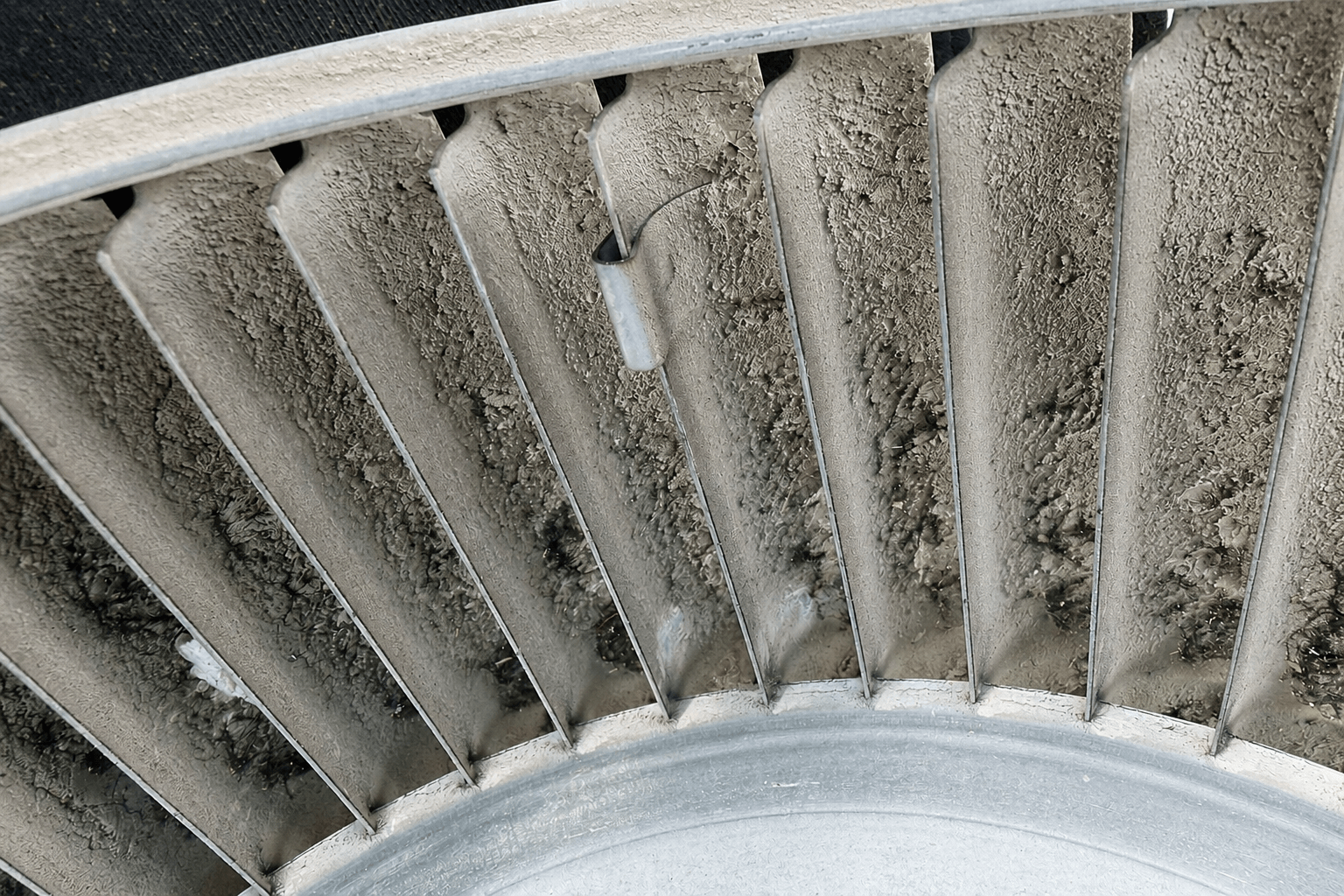
Some vents blow hard and the back bedroom gets nothing. Or the first thirty seconds after the system kicks on carry a musty smell through the whole house. Nine times out of ten that is the blower wheel — the squirrel cage inside your air handler — wearing a coat of dust that took years to build.
Here is why it matters more than it sounds. Every blade on that wheel is a little scoop, shaped to grab a specific amount of air. Put a sixteenth of an inch of felt on each one and they stop scooping. The system starves: weak vents, run times that never end, a coil that freezes in July because there is not enough air crossing it, and a motor pulling more amps than the nameplate says it should.
The way we confirm it is static pressure. Most residential systems are designed around half an inch of it. When we put the manometer on an air handler with a loaded wheel we routinely read well past that — the system is fighting itself, and no thermostat setting is going to fix that.
Signs your equipment needs this
- Airflow is noticeably weaker at the vents than it used to be
- A musty or stale smell comes through the vents when the system starts
- Some rooms never reach temperature no matter how long the system runs
- The air handler is louder than it used to be, or vibrates
- The indoor coil freezes up during hot weather
Two levels: which one do you need?
Maintenance level. Performed with the equipment in place — no disassembly. The right call for equipment that gets serviced regularly.
Restoration level. The equipment comes apart and is pressure-washed with the right chemicals, then reassembled and performance-tested.
Not sure which one? Book the Light clean. If the technician opens the equipment and finds it needs more, you upgrade to Deep on the spot and pay only the difference.
What the technician actually does
- We measure static pressure and airflow at the air handler to confirm the wheel is the restriction.
- Power is locked out at the disconnect before any panel comes off.
- In-Place: the blower housing is opened and the wheel is cleaned in position with brushes, vacuum and approved cleaner.
- Deep Clean: the entire blower assembly is pulled out, washed blade by blade, checked for balance and reinstalled — the only way to get every blade truly clean.
- The system is reassembled, restarted, and airflow is measured again so you can see the difference.
Pick your day and time, confirm with a deposit, and you get the confirmation right away. No phone tag, no waiting on a callback, no estimate visit.
Book Blower Wheel Cleaning — from $199
Frequently asked questions
Why does the blower wheel get so dirty?
Every cubic foot of air in your home passes through it. Even with good filters, fine dust builds on the blades over the years — and if a filter was ever missing or installed loose, it builds fast.
What is the difference between In-Place and Deep?
In-Place cleans the wheel where it sits, which handles moderate buildup in about seventy-five minutes. Deep pulls the whole blower assembly out so every blade is washed and the wheel is checked for balance — that is what a heavily caked wheel needs, and it runs two hours.
Will this fix my weak airflow?
If the wheel is the restriction, yes, and we measure before and after so it is not a matter of opinion. If we find the real problem is somewhere else — a collapsed duct, an undersized return, a failing motor — we tell you that instead of selling you a cleaning that will not help.
Is a dirty blower wheel a health issue?
That coating holds dust and can grow mold in humid weather, and it is sitting directly in the air you breathe. That is why the musty smell shows up when the system starts — you are smelling the wheel.
Do I need my ducts cleaned too?
Usually not. In most homes the blower wheel and the coil hold the buildup, not the duct runs. We will tell you honestly if we see something in the ducts worth addressing.
Where we work
Equipment down right now, or something bigger than standard?
Call or text and we will take care of it.